Despite the
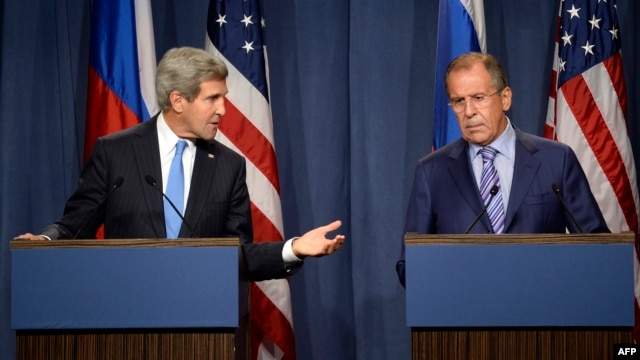
recent Russian-lead move to seek out a diplomatic solution to the crisis in
Syria, the United States continues to prepare for armed conflict in the region.
While plans for multiple surgical air and missile attacks appear to be on hold
for the time being, the U.S. has begun to arm rebel groups in Syria.
In an
editorial published in The Nation on
September 10, staff writer Michael T. Klare postulated that “…even if [Syrian]
President Bashar al-Assad agrees to demands for the swift destruction of his
chemical arsenal under international supervision, the White House will insist
on its prerogative to employ force in the even of cheating or backsliding by
the Syrians.” A major question that arises in the face of a growing international
move toward diplomacy with Syria, as well as growing domestic opposition to
military action both in Congress and among the general public: Why the
continued insistence of use of military force? Ostensibly, a U.S. attack in the
area would work to discourage the Assad regime from future use of its chemical
weapons arsenal as well as crippling its ability to do so. However, those in
favor of a military solution have defended their stance with a myriad of other
reasons including the reaffirming of America’s credibility as a super power
(both as a warning symbol to the would-be Assads of the world, and as a symbol
of protection to its allies across the globe), the aiding of rebel forces in the
area, and others.
Klare
writes that there are other more subtle interests motivating those in favor of
military action, namely the “perceived need to protect America’s geopolitical
interests in the Middle East.” To be more precise, this deals with a need to
protect crude oil deposits in the area. Absent separate space for a
semester-long course on 20th century American foreign policy
specifically in the Middle East, essentially the U.S. had no real geopolitical
or strategic interest in the region until after World War II, when oil was
discovered in the area and it became a fundamental interest.
Acknowledged
or not, dominance of energy sources remains a fundamental interest of the
United States, and I would argue at the very least, no action is taken the
Middle East without consideration of that interest. Now, this is not to make a
simplistic and somewhat lazy argument that all U.S. actions in the area can and
should be seen only through the lens of dependence on foreign oil. Klare does
not make that argument, and neither will I. Klare argues that America’s
geopolitical mission in the Middle East has come at too high a cost, and has
degraded our image in the world instead of enhancing it. He acknowledges
President Obama’s plan to focus greater emphasis on the Asia-Pacific region,
something the President calls, “the pivot to Asia.” However, he argues that
despite his best efforts, Obama is inescapably tied to the legacy of his
predecessor, and the country’s history in the Middle East. He finally argues
that essentially the long term implications of our geopolitical actions in the
region will not yield positive consequences for any party involved and that we,
as a country, should seek to extricate ourselves from the region – an act that
cannot be done without abandoning the “strategic imperatives that have governed
American foreign policy in the region for so many years and fashion a new set
of guiding principles.”
I agree
with Klare. The only way to change foreign policy in the region is to
re-examine the premises that govern it and always have. I do not think a full
extrication of U.S. involvement in the region can or more importantly should be
sought. Whether we like it or not, isolationism and all its arguments are part
of an extinct, irrelevant ideology. We are part of a world community of nations
now, and for the sake of mutual survival and prosperity, we must continue to
monitor each other openly. It must be known that there are actions that cannot
be allowed to be taken whether its Syria gassing its citizens with Sarin, or the
unchecked and unwarranted settling of Israeli citizens on the West Bank, the
proliferation of Taliban or al Qaeda influence anywhere, or most horrifically
the growing prospect of a nuclear Iran.